Monday, October 20, 2008

MMI Images, 1900-1956

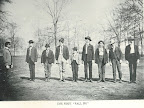
The first “Fall In,” circa 1900.


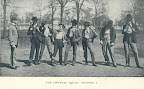
The Awkward Squad, October 1st, from the 1900 MMI yearbook, The Reveille.


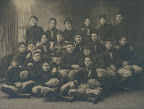
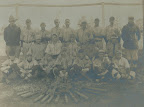
The 1900 Football Team with Hopson O. Murfee as team manager.


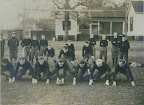
The 1914 Football Team. Note the wooden goal post!


The 1915 Baseball Team.


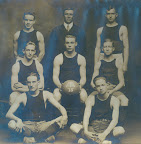
The 1915 Basketball Team.


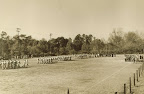
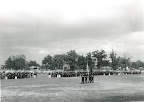
A World War II-era image of the Corps of Cadets marching onto the football field at MMI.


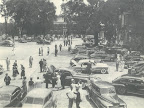
Parking on the blacktop in front of the tree-lined Chapel from the 1949 Orange and Black, MMI’s yearbook.


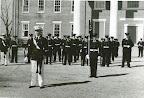
A Dress Parade in the 1950s.


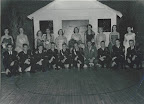
The Christmas Cotillion of 1952.


“C” Company during Annual Inspection, 1955-1956.


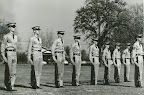
“A” Company as the Honor Squad of Field Day, 1955-1956.

Monday, October 13, 2008

The Dr. Thomas Perkins Abernethy Collection of Americana

(Dr. Thomas Perkins Abernethy, 1890-1975)

The Abernethy Collection, the select private library of Dr. Thomas Perkins Abernethy, was donated by Abernethy to Marion Military Institute, circa 1970. The collection consists of some 950 volumes including many first editions and rare books, the oldest being published in 1779. Seven books written by Dr. Abernethy are also part of the collection.

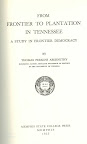
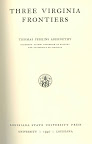
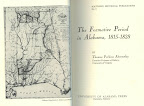
Here are three of Dr. Abernethy’s historical books centering on Tennessee, Virginia, and Alabama:

Tennessee


Virginia


Alabama


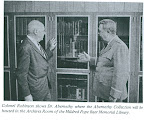
MMI President Paul B. Robinson with Dr. Abernethy in the Archives Room of the Baer Memorial Library.


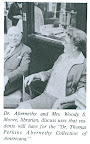
Dr. Abernethy conversing with Mrs. Woody S. Moore, MMI Librarian, about the donation of his personal library to MMI.


Born in Collirene, Alabama, on August 25, 1890, Thomas Perkins Abernethy was a member of the Marion Military Institute Class of 1908 (he was a cadet sergeant and played on the football team), and a 1912 graduate of the College of Charleston in South Carolina. He also taught at MMI for a number of years (1912-1914, 1919-1921) while completing his graduate work (M.A., 1915; Ph.D., 1922) in history at Harvard University in Massachusetts.

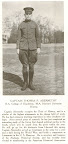
Captain Abernethy held the Chair of History at MMI.


Dr. Abernethy married Ida Robertson, the secretary to the president of Marion Military Institute, on December 6, 1917.

Upon completion of his graduate studies at Harvard, Dr. Abernethy embarked upon a distinguished career as a Southern historian and professor. He taught at Vanderbilt University, the University of Chattanooga, and the University of Alabama, before joining the faculty at the University of Virginia as the Richmond Alumni Professor of History in 1930. Dr. Abernethy’s career culminated in his serving as chair of the Corcoran Department of History at UVA, one of the premier departments of history in the country. He retired from UVA in 1961, but also taught briefly at the University of Texas and the University of Arizona.

Dr. Abernethy received an Honorary Doctor of Literature (Litt. D.) from Washington and Lee University in Lexington, Virginia. He was also honored by a festschrift entitled The Old Dominion: Essays for Thomas Perkins Abernethy, edited by Darrett B. Rutman (1964).

Among his many contributions to the field of history, Dr. Abernethy co-founded and served as third president of the Southern Historical Association. He also served on the executive board of the Virginia Historical Society in Richmond for over a quarter century.

Dr. Thomas Perkins Abernethy – a true son of MMI - died in Charlottesville, Virginia, on November 12, 1975.

Tuesday, October 7, 2008

Don't Quit Your Day Job!

Recently, several folks here at MMI have asked about my musical background as a drummer (no contradiction in terms!). I simply tell them that that was my “other life,” my misspent youth, if you will, and let it go at that.

When I served on the staff at Bridgewater College in Virginia (1993-2005), some student friends of mine spread the rumor that I had played drums in the Grateful Dead! For years, a giddy freshman would come up to me and ask about the Dead and what Jerry Garcia was really like!? I’d set them straight, and they would wander off disappointed.

So, here is the real skinny on my drumming career! There’s nothing to really brag about, but the Alabama Music Hall of Fame did list me as one of “Alabama’s Music Achievers” in 1999. Thanks, y’all!

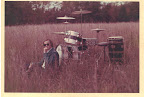
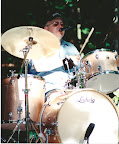
I played drums in working bands, off and on, from 1964 to 2005 (ages 14 to 55). My last bands were BC Rockers, a classic rock band, and the Wes Allen Trio, a jazz group, both in Virginia.

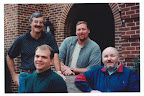
BC Rockers, the infamous classic rock band from Virginia. We immortalized COL Benson in song! I’m the old guy on the right!


I am not currently playing in a group and that’s good. I have a day job and I’m paying the bills and that’s fine for now. I go to bed early and get up early and I kinda like the lifestyle. No more crazy travelling, late night gigs, and dining at The Krystal at three in the morning!

Here are some representative images from more than 40 years of gigging (please forgive):

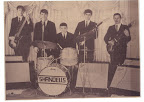
The Shandells (1964-1968). Friends from Butler High School in Huntsville (my brother is second from right), we released two singles on Woodrich Records, signed with London Records, recorded in Nashville and Muscle Shoals, and signed with Dino Productions in Nashville.


A Playbill from 1966.


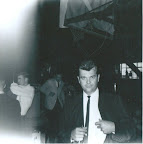
Hanging backstage with rocker Conway Twitty (before he went Country), 1967.


The Sensational Prophets (1968-1970). The “Blue-eyed Soul Band of the South,” the classic frat party horn band. We worked out of Southeastern Attractions in Birmingham and Anthony Attractions in Tuscaloosa, playing the Greek circuit at colleges and universities throughout the Deep South. I’m the cute one standing on the right!
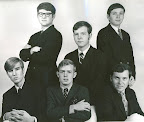


A publicity shot from 1969, the year of Woodstock.


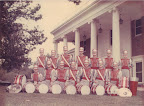
The “Marching Southerners” Drumline (1968-1971) at Jacksonville State University. A formally trained percussionist, I played in the school bands at Westlawn Middle School and Butler High School in Huntsville, and then at JSU. I’m second from the right, front row.


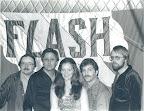
Flash, a 1980s rock band from Huntsville, was a family affair, as well. My brother is next to me, his wife is next to him, her brother is next to her, and our “cousin” completes the lineup. Three of us were former members of The Shandells who also played together in the Barkley-Almon Band in the 1970s.


Finally, I do perform with the Grey Drummers, the alumni (1950s – 1980s) of the JSU “Marching Southerners” Drumline. Yes, we’re old and in the way, but we actually play rather well!
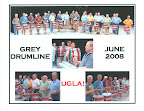


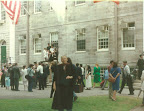
The old joke is: Who usually hangs out with musicians? Answer: The drummer! So, just to prove that a drummer can have a (bald) head on his shoulders, here is my graduation from Harvard in 1990! So there.


I decided to go out with a bang! The End.
Monday, September 29, 2008

Breckinridge Military Hospital (1863-1865) on the Marion campus

In the Spring of 1863, Dr. William Augustus Evans was sent by the Confederate Medical Department to Marion to locate a suitable site near the railroad for a medical facility. After first looking at Judson College, which was in session with some 250 students, Evans recommended that Howard College be secured as the hospital site. At that time, Howard had only one professor and 27 students, mostly of academy age, 24 of whom were from the town of Marion. The majority of Howard’s students and alumni were serving in various Confederate units fighting in the war.

The Board of Trustees of Howard College reluctantly agreed in August, 1863, to offer its property to the Confederate government to establish Breckinridge Division Hospital, but referred to generally as Breckinridge Military Hospital.

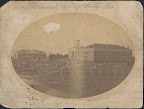
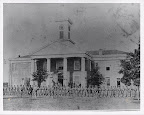
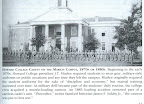
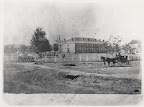
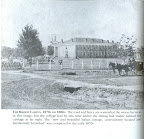
The Howard College campus that was Breckinridge Military Hospital from 1863 - 1865. The image is from the late 1860s or early 1870s. (Samford University Special Collections)


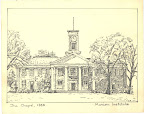
A drawing of the Howard College/MMI Chapel from an old postcard. (MMI Archives)


The College Chapel was converted into a major wing of the hospital, the pews being used by the more seriously ill patients, with the other rooms serving as administrative offices and operating rooms. The two dormitories were named Wards A and C, and were utilized by the less seriously ill soldiers. A tent encampment for the overflow of patients dotted the front campus.

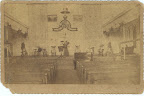
An old image of the interior of The Chapel. Note the balconies on either side and the two pot-bellied stoves with piping. (MMI Archives)


Drs. William Augustus Evans and James McCown Greene were placed in charge of Breckinridge Hospital. However, one Willie Banks, an African American slave woman who served as the night nurse at the hospital, claimed that Dr. John Thomas Barron of Marion (a member of the first graduating class at Howard College), was actually the medical officer in charge.

Most of the hospital records were lost or destroyed. However, one existing volume (now at Samford University) from August, 1863, to December, 1864, indicates that there were 406 patients at the hospital. The number of soldiers who died is unknown (many remains were sent back to their homes), but 102 graves were once located in a pine grove behind the College Chapel. Following the Civil War, these graves, including the unknowns, were re-interred in the cemetery of St. Wilfrid’s Episcopal Church in Marion.

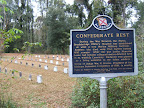
The Confederate cemetery at St. Wilfrid’s Episcopal Church in Marion. (Photo by Mark Griffiths)


Federal troops entered Marion from Selma in early April, 1865. They took over Breckinridge Hospital and paroled the remaining Confederate soldiers there and in town, the war being essentially over. With Union troops occupying the College buildings, one dormitory was designated to house freed slaves from Perry County planters, a move strongly protested by the Howard College Board of Trustees.

Tuesday, September 23, 2008

The Oldest Images of the Marion Campus, Plus Harry, The Hero Slave

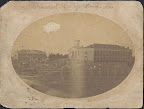
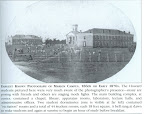
Here are the three oldest known photographs of Howard College, now Marion Military Institute, courtesy of the Samford University Special Collections in Birmingham (thanks, Jennifer Taylor). The originals are paired with the same images as printed in 160 Years of Samford University: For God, For Learning, Forever (Arcadia, 2001) by Sean Flynt.


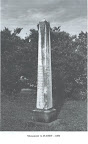
Finally, here is an image of the obelisk to Harry, the hero-slave, in the Marion city cemetery. On the night of October 15, 1854, the four-story brick Howard College building (then located near the Siloam Baptist Church in Marion) burned. Harry, slave of Howard’s president, Henry Talbird, who also served as the College janitor, saved the lives of the students at the cost of his own. Awakened at midnight and told to save himself, he replied, “I must wake the boys first.” Harry then proceeded to knock on doors and rouse students up to and including the fourth floor when the flames overtook him. Harry died from injuries sustained from jumping from the fourth floor. One student and a tutor eventually died from injuries sustained in the fire.

Harry was buried as a hero in the Marion cemetery and a marble monument to his bravery was erected by the students of Howard College and the Alabama Baptist Convention. President Talbird of Howard College, President Miles P. Jewett of Judson College, and the later Confederate general, Isham W. Garrott, supervised the erection of the monument and its public dedication.

Monday, September 15, 2008

When Hollywood came to Marion (and other Bits and Pieces)


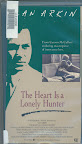
In 1968 Warner Brothers released their film adaptation of Carson McCuller’s classic novel, The Heart Is a Lonely Hunter. The cast included a young Alan Arkin and a equally young Sondra Locke and Stacy Keach, among others. Arkin was nominated for an Academy Award for his role as Singer in the film; he did win the New York Film Critics Award as Best Actor.

Singer is a deaf-mute who uses sign language to communicate with his fellow deaf-mute friend (played by Chuck McCann) who is also a mentally-challenged man-child who is constantly getting into trouble with the law. His guardian (an uncle) finally has him committed to the state mental hospital.

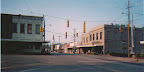
Shot mainly in Selma, Alabama, I was surpised to see that the first ten minutes of the film were actually done in Marion! The Perry County Courthouse and various businesses around the square (most of which no longer exist) are featured in several scenes. The biggest surpise, at least to a relative newcomer to the area like myself, was seeing a thriving downtown Marion during the late 1960s.

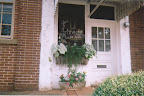
A memorable scene in the movie shows the mentally-ill character breaking a bakery window in Marion (setting off the alarm) and gorging himself on pasteries while stealing the bride and groom off the top of a wedding cake. Two policemen arrive to arrest their “best customer.” Singer (Alan Arkin) arrives on the scene just a bit too late to help his friend.
The bakery window today is Jim’s Artifacts across from the Perry County Courthouse.


The final scene in Marion shows Singer (Arkin) putting his mentally-ill friend on a bus across from Nathan Harris’ bound for the state hospital. The steeple of Siloam Baptist Church looms in the background above the bus. The bus then turns left past the old hotel.

The scene of the last scene filmed in Marion!


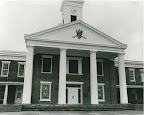
The following two photographs of the MMI Chapel were made by an old friend of mine, Larry Hice, some thirty-odd years ago during one of our many “road trips” around Alabama from Huntsville. I thought you would enjoy seeing them.


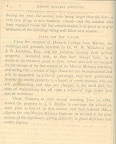
These two scans are from the very first Marion Military Institute catalogue of 1888, published after the close of the first session, 1887-1888. Page two shows that there were both high school and college level students in the Corps from the very beginning. The article on pages 2-3 mentions that the school first opened on October 4, 1887, and that the Trustees rented the campus property to James T. Murfee on June 12, 1888, for the sole purpose of conducting the school on the same plan as the first session.


Finally, as a follow-up to the blog on Henry and Julia Tutwiler’s famed Green Springs School near Havana, Alabama, this tiny sign is the only remaining evidence on a public road that Green Springs (a former resort before it became the school) ever existed. None of the buildings remain and the private property is fenced and gated and utilized primarily for logging and hunting.
The little sign is near a lonely intersection in Hale County

Friday, September 5, 2008

The Rev. Nathaniel Crawford, Jr., J 1972 - MMI’s first African American cadet and graduate

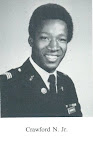
Image of Cadet Sergeant First Class Nathaniel (Nate) Crawford, Jr., J 1972


Marion Military Institute’s first African American cadet and graduate was Nathaniel Crawford, Jr., of Tarpon Springs, Florida. Nate entered the Institute in 1970 as a first year college student, and he graduated with the A.A. degree in the Class of 1972.

At MMI, Crawford held rank as a Sergeant First Class in “A” Company, and he played varsity baseball (pitcher) and basketball (a top player) both his college years. He was a member of the Monogram and Athletic Clubs, he made the Commandant’s List his second year, and he received the Excellence in Citizenship award in 1971-1972.

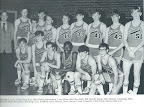
Nate was an outstanding player on the college basketball team.


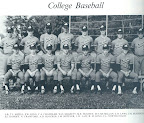
He pitched for the college baseball team.


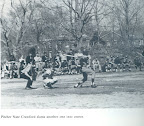
Nate at bat.


The team captains with Alabama Coach Paul “Bear” Bryant who was the guest speaker at the MMI Sports Banquet in 1972.


Nate Crawford completed the Master of Divinity (M.Div.) degree at the Interdenominational Theological Center (ITC) in Atlanta, Georgia, and then took the degree of Master of Social Work (M.S.W.) from the Atlanta School of Social Work, Clark Atlanta University.

The Rev. Crawford served as a career Air Force Chaplain, rising to the rank of Colonel. COL Crawford retired two years ago as Chaplain of the 375 Airlift Wing at Scott Air Force Base in Illinois. He and his family settled on Florida’s West Coast. COL Crawford is married and the father of three grown children.

His son, Isaac A. Crawford, graduated from MMI with the A.A. degree in 1999.

Isaac A. Crawford, J 1999